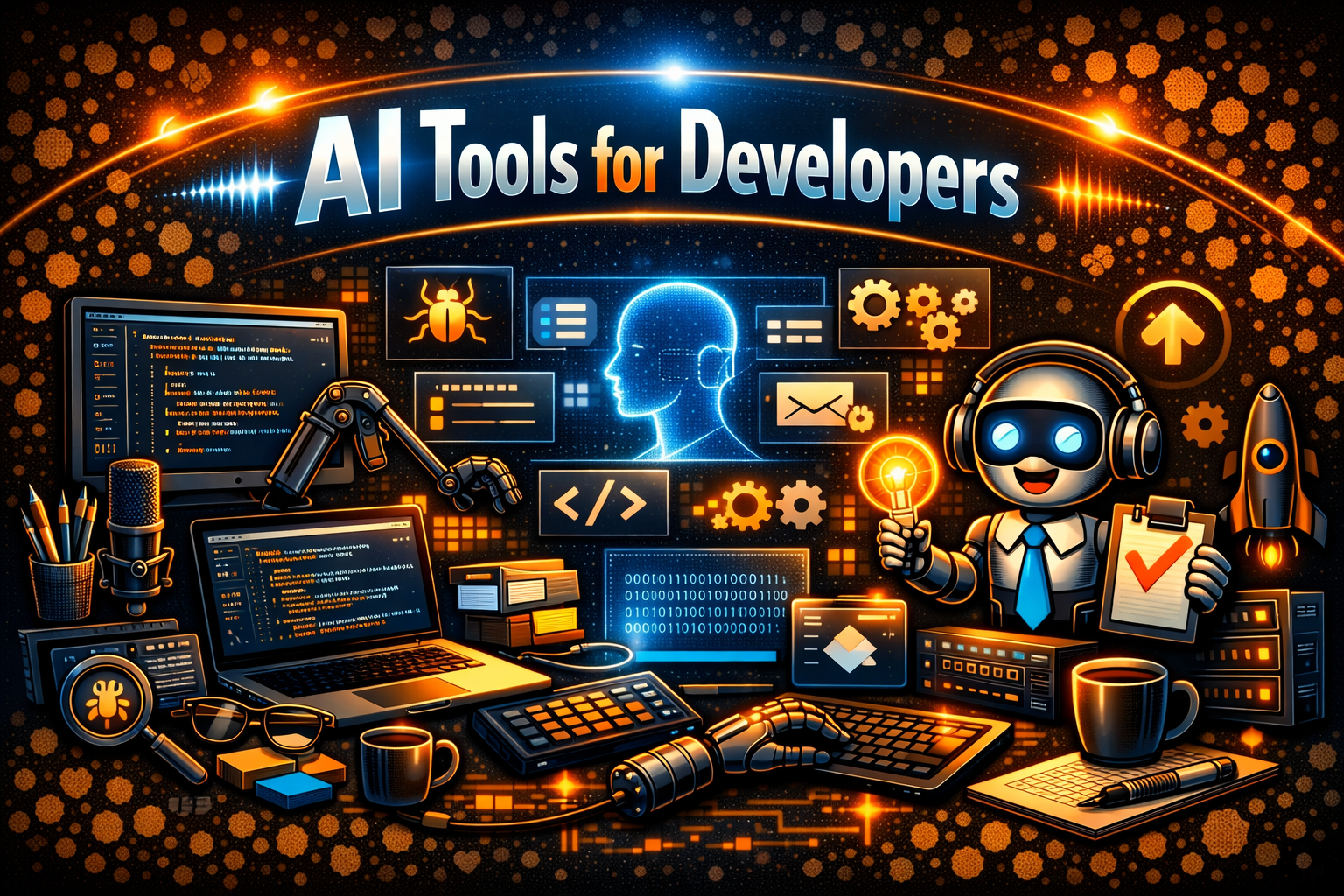
AI Tools for Developers: Complete Guide
AI tools for developers changed how I build, debug, and ship software. They turned coding from a linear process into a creative loop — where ideas, prototypes, and optimizations happen in real time. I can write cleaner code, catch errors faster, and automate the boring parts so I can focus on architecture and logic.
I don’t use these tools to replace developers. I use them to amplify them. To make development faster, smarter, and more collaborative. They help me move from concept to production without losing momentum.
This page is how I understand the AI‑for‑developers category after testing everything that matters — the tools that actually improve development, not just generate code.
⭐ Quick Navigation
- What this category is
- Why it matters
- Types of AI tools for developers
- Real use cases
- How they work
- How to choose
- Common mistakes
- My simple framework
- Internal links
- Final thoughts
⭐ Category Snapshot
What it is: Tools that assist with coding, debugging, documentation, and deployment using AI. Who uses it: Developers, engineers, founders, product teams, and technical creators. What problems it solves: Slow coding cycles, repetitive tasks, unclear documentation, and debugging bottlenecks. Where it fits: Software development, automation, testing, DevOps, and technical writing.
⭐ What AI Tools for Developers Actually Are
AI developer tools use language models, code analysis, and automation to help you:
- write and refactor code
- detect and fix bugs
- generate documentation
- automate testing
- optimize performance
- manage deployments
- integrate APIs faster
They’re not about replacing developers — they’re about removing friction from development.
⭐ Why AI Tools for Developers Matter
Software development is complex, but most of the pain comes from repetition — not creativity. Traditional workflows involve:
- writing boilerplate code
- debugging manually
- documenting features
- testing edge cases
AI tools compress that entire process. They let you:
- generate code instantly
- catch errors before runtime
- document automatically
- test continuously
- deploy with confidence
For developers and teams, this is leverage.
⭐ Types of AI Tools for Developers
After testing everything from GitHub Copilot to Replit Ghostwriter to Tabnine, the category breaks into clear groups.
1. AI Coding Assistants
Generate, refactor, and explain code. Use when you need speed and clarity.
2. AI Debugging Tools
Detect, diagnose, and fix errors automatically. Use when you need reliability.
3. AI Documentation Tools
Generate and maintain technical docs. Use when you need consistency.
4. AI Testing Tools
Create and run automated tests. Use when you need coverage and confidence.
5. AI DevOps & Automation Tools
Handle builds, deployments, and monitoring. Use when you need scale and stability.
⭐ Real Use Cases
Here’s where I use AI developer tools every week.
Coding & Refactoring
- writing new features
- cleaning legacy code
- converting languages
- optimizing performance
Debugging & Testing
- catching runtime errors
- generating test cases
- validating edge conditions
- improving reliability
Documentation & Learning
- generating API docs
- explaining complex logic
- onboarding new developers
DevOps & Automation
- automating builds
- managing CI/CD pipelines
- monitoring performance
- predicting failures
If it involves code, AI tools make it faster and cleaner.
⭐ How AI Developer Tools Work (Simple Explanation)
Most tools follow the same pattern:
- You input code, commands, or context.
- The model interprets your intent.
- It generates, analyzes, or optimizes code.
- You review and refine.
- It integrates directly into your workflow.
The real difference between tools comes from:
- language support
- integration depth
- accuracy
- speed
- workflow fit
Two tools can use similar models but feel completely different in practice.
⭐ How I Choose the Right AI Developer Tool
Here’s how I personally decide what to use.
If I want speed → I choose a coding assistant
Perfect for writing and refactoring.
If I want reliability → I choose a debugging tool
Perfect for catching errors early.
If I want clarity → I choose a documentation tool
Perfect for onboarding and maintenance.
If I want confidence → I choose a testing tool
Perfect for validation and QA.
If I want scale → I choose a DevOps automation tool
Perfect for deployment and monitoring.
⭐ Common Mistakes I See
These are the mistakes that slow developers down:
- relying on AI without understanding the code
- skipping manual review
- ignoring version control
- using too many overlapping tools
- neglecting security and compliance
Avoid these and your workflow becomes instantly stronger.
⭐ My Simple Framework
This is the model I use to evaluate AI developer tools:
1. Does it save time without breaking trust?
Speed means nothing if the output isn’t reliable.
2. Does it fit my stack?
Integration beats novelty.
3. Does it make me a better developer?
Tools should teach, not just automate.
⭐ Final Thoughts
AI developer tools didn’t just make coding faster — they made it more creative. I can test ideas instantly, refactor without fear, and focus on solving problems instead of fighting syntax. That freedom changes how you build.
The real advantage isn’t automation; it’s acceleration. When your tools help you think faster, you build better. That’s what these tools give you — not just code, but clarity.
If development has ever felt slow or repetitive, AI tools for developers will change how you build — the same way they changed how I create everything.