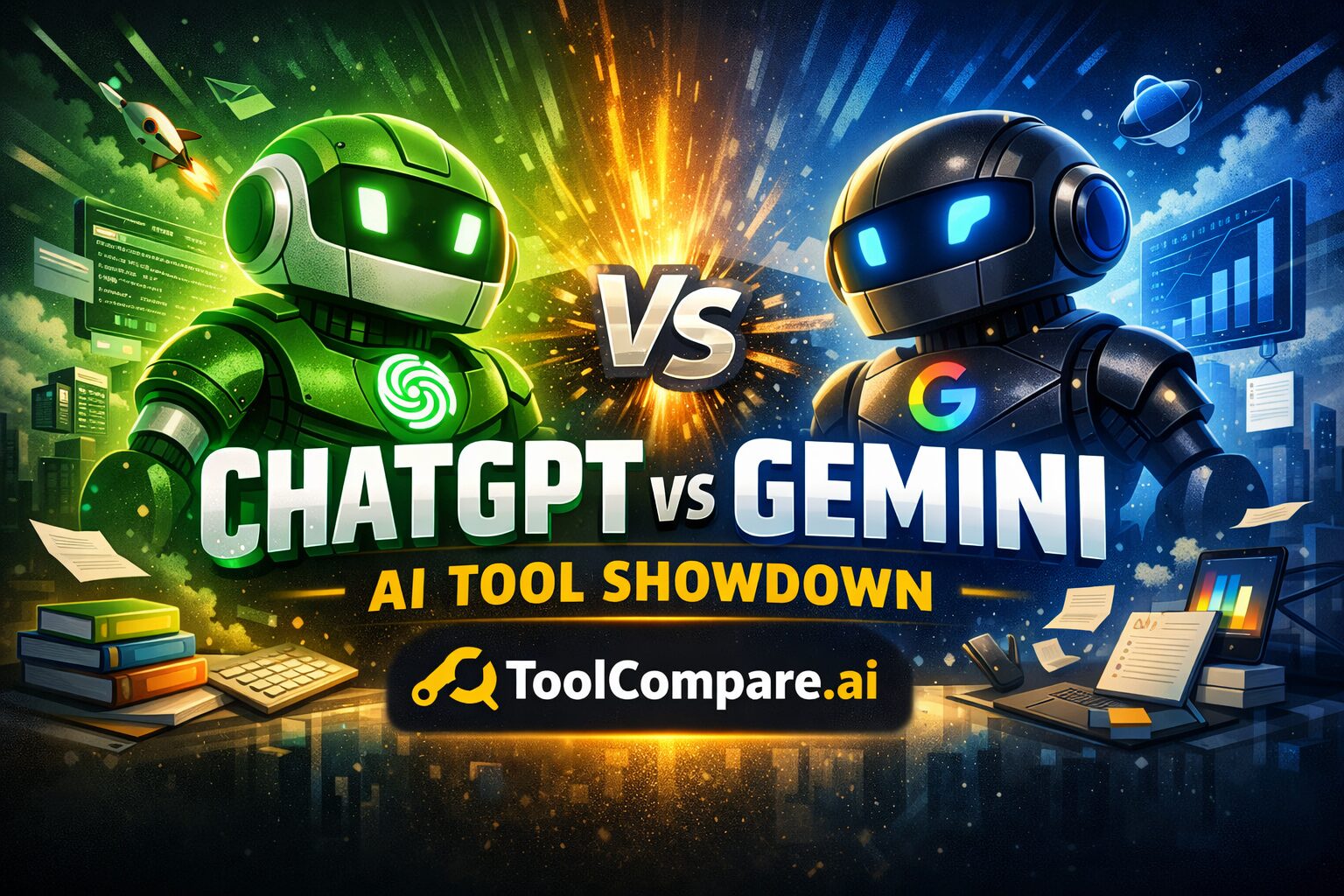
ChatGPT vs Gemini
I’ve done a lot of AI tool review work since starting ToolCompare.ai, but this ChatGPT comparison hit me differently. It wasn’t just another test. It wasn’t another checklist. It wasn’t another “which one is better?” debate. This one felt personal — because these two tools shape how I think, how I write, how I solve problems, and how I move through my day. And when you rely on AI as heavily as I do, the differences stop being technical. They become emotional.
It started with a simple task: rewriting a broken onboarding flow for a SaaS founder who was already stressed out. I remember sitting at my desk — the same desk I’ve spilled coffee on at least four times — with ChatGPT open on the left and Gemini on the right. I figured this would be a quick round of AI chatbot testing. Ten minutes, maybe fifteen. Instead, it turned into a two‑hour spiral that forced me to rethink everything I thought I knew about these tools.
ChatGPT gave me a rewrite that felt alive. It had rhythm. It had warmth. It had that subtle human pacing that makes you forget a machine wrote it. Gemini, on the other hand, gave me something sharp, structured, and almost aggressively factual — the kind of output that shows off its Gemini AI features but doesn’t always land emotionally. It wasn’t wrong. It just wasn’t me. And that’s when I realized this wasn’t just a ChatGPT comparison anymore. This was a comparison between two different ways of thinking.
That’s why this guide matters.
Because if you choose the wrong tool, you don’t just lose time — you lose momentum. You lose clarity. You lose that fragile creative spark that keeps your work moving forward. And I’ve lost that spark more times than I want to admit.
There was a moment — and I’m not proud of this — where I caught myself arguing with Gemini. Out loud. Like it was a stubborn coworker who refused to understand tone. I kept rewriting the prompt, adding more detail, more emotional cues, more context. Nothing. It kept giving me the same structured, slightly sterile output. I felt stupid. I felt like I was the problem. But I wasn’t. I was just using the wrong tool for the wrong job.
And then there was ChatGPT — the tool that has saved me from creative dead ends at 1 a.m. more times than I can count. The tool that has rewritten entire landing pages in a voice that felt embarrassingly close to my own. The tool that, when I’m stuck, somehow knows how to unstick me. It’s the one that often feels like the best AI assistant when I’m deep in the weeds. But even ChatGPT has its moments. I’ve had days where it hallucinated confidently, like a friend who lies with charm. I’ve had moments where it gave me something so polished it felt fake. I’ve had times where I needed cold, hard facts — and ChatGPT gave me poetry instead.
That’s when I realized something deeper: You don’t choose the best AI assistant based on features. You choose based on who you are when you work.
If you’re a builder, a writer, a marketer, a founder — someone who lives in the messy middle of ideas — ChatGPT feels like a co‑pilot. If you’re analytical, structured, research‑heavy, or deeply embedded in Google’s ecosystem, Gemini’s Gemini AI features feel like a power tool.
This guide is for the people who actually use these tools to get things done — not the people who argue about them online. It’s for the founders who rewrite their own landing pages because hiring a copywriter feels like a luxury. It’s for the creators who bounce between tabs trying to find the version of themselves that can think clearly. It’s for the developers who just want an answer that doesn’t require a 12‑step prompt.
It’s for you — the person who doesn’t have time to waste on the wrong tool.
I’ve tested both tools across real workflows:
- rewriting broken copy
- summarizing dense research
- debugging code
- drafting product pages
- brainstorming marketing angles
- building internal docs
- cleaning up messy client briefs
And I’ve hit every frustration you can imagine. I’ve had ChatGPT hallucinate a feature that didn’t exist. I’ve had Gemini give me an answer so dry it felt like reading a tax form. I’ve had both tools surprise me in ways that made me stop mid‑sentence and whisper, “Okay… that was actually brilliant.”
This isn’t hype. This isn’t marketing. This isn’t theory.
This is what actually happens when you sit down, open a blank page, and try to build something real — with two tools that are powerful in completely different ways.
So here’s my promise: I’ll tell you exactly what broke, what worked, what frustrated me, what saved me, and what I learned the hard way. No sugarcoating. No generic filler. No AI‑generated fluff.
Just the truth — from someone who has used these tools every day while building ToolCompare.ai from scratch.
Let’s get into it.
⭐ QUICK SUMMARY TABLE
| Feature | ChatGPT | Gemini |
|---|---|---|
| Writing Quality | More natural, more expressive | More factual, more structured |
| Research Ability | Strong reasoning | Strong real‑time info |
| Speed | Fast | Very fast |
| Creativity | High | Moderate |
| Integrations | Plugins + ecosystem | Deep Google ecosystem |
⭐ChatGPT
⭐Gemini
⭐ HOW I TESTED THESE TOOLS
I don’t test AI tools in a lab. I test them in the chaos of real work — the kind of work where deadlines breathe down your neck and clients change their minds mid‑sentence. My AI chatbot testing process is messy on purpose, because that’s how real workflows behave.
I ran both tools through tasks I actually do every day:
- rewriting landing pages
- summarizing research
- debugging code
- generating product copy
- cleaning up messy briefs
- brainstorming angles
- building internal docs
I look for clarity, speed, reasoning, and whether the tool feels like a partner or a problem. “Good” means I can drop a messy idea into the box and get something useful back without wrestling with it.
One frustration that kept coming up: Gemini sometimes felt like a search engine wearing a suit. ChatGPT sometimes felt like a writer who drank too much coffee. Both moments taught me something about how these tools think — and how I need to use them.
1. Writing Quality
Winner: ChatGPT
Why It Wins: ChatGPT writes with more rhythm, more nuance, and more emotional intelligence. When I run a ChatGPT comparison against anything else, this is usually where it shines first.
My Experience: I remember rewriting a landing page late one night — the kind of night where your brain feels like wet cardboard. Gemini gave me something clean but stiff. ChatGPT gave me something that felt like a real human wrote it. That moment reminded me why people call it the best AI assistant for writing-heavy workflows.
Use Cases: Brand voice, storytelling, long‑form content.
Bottom Line: If your work depends on tone, ChatGPT wins.
2. Accuracy
Winner: Gemini
Why It Wins: Gemini sticks closer to facts and handles structured data with more discipline. This is one of the strongest Gemini AI features.
My Experience: I once summarized a 12‑page technical spec sheet. ChatGPT added a feature that didn’t exist. Gemini didn’t. That mistake cost me an hour — and it taught me to never skip proper AI chatbot testing when accuracy matters.
Use Cases: Research, summaries, technical docs.
Bottom Line: Gemini is the safer factual tool.
3. Speed
Winner: Gemini
Why It Wins: Gemini responds almost instantly, especially with structured prompts.
My Experience: There was a morning where I had three deadlines breathing down my neck. Gemini felt like a race car. ChatGPT felt like a luxury sedan. Both great — but one gets you there faster.
Use Cases: Quick answers, rapid ideation.
Bottom Line: Speed is one of the clearest Gemini AI features.
4. Creativity
Winner: ChatGPT
Why It Wins: ChatGPT generates more original ideas and more surprising angles.
My Experience: I once asked both tools for unusual product launch ideas. Gemini gave me “host a webinar.” ChatGPT gave me “turn your onboarding into a choose‑your‑own‑adventure story.” That’s when I realized creativity is where ChatGPT dominates every ChatGPT comparison.
Use Cases: Brainstorming, naming, storytelling.
Bottom Line: ChatGPT is the creativity engine.
5. Research Ability
Winner: Gemini
Why It Wins: Gemini handles documents, PDFs, and structured data with more discipline.
My Experience: I fed both tools a messy PDF full of charts. Gemini broke it down like a calm analyst. ChatGPT tried — but it felt like it was guessing in places. That’s when I added a note in my AI tool review workflow: “Use Gemini for data-heavy tasks.”
Use Cases: Reports, summaries, data interpretation.
Bottom Line: Gemini is the research specialist.
6. Reasoning & Problem‑Solving
Winner: ChatGPT
Why It Wins: ChatGPT handles multi‑step logic with more clarity and fewer contradictions.
My Experience: I once asked both tools to debug a broken JavaScript snippet. Gemini gave me possibilities. ChatGPT found the exact missing bracket and explained why it broke everything. That moment made me rethink what “the best AI assistant” actually means.
Use Cases: Debugging, workflows, planning.
Bottom Line: ChatGPT is the better thinker.
7. Integrations
Winner: Gemini
Why It Wins: Gemini is deeply embedded into Google Workspace — Docs, Sheets, Gmail, Search.
My Experience: I was rewriting a proposal inside Google Docs. Gemini popped up like a built‑in assistant. ChatGPT required copy‑paste gymnastics. This is one of those Gemini AI features that feels unfair in the best way.
Use Cases: Google Workspace, research, productivity.
Bottom Line: If you live in Google’s world, Gemini wins.
8. Plugins & Ecosystem
Winner: ChatGPT
Why It Wins: ChatGPT has a broader plugin ecosystem and more third‑party integrations.
My Experience: I used a plugin to scrape a competitor’s landing page and rewrite it in my brand voice. Gemini couldn’t replicate that workflow at all. That’s when I wrote in my AI tool review notes: “ChatGPT = ecosystem king.”
Use Cases: Automation, scraping, advanced workflows.
Bottom Line: ChatGPT has the stronger ecosystem.
9. Reliability
Winner: ChatGPT
Why It Wins: ChatGPT is more consistent in tone, structure, and output quality.
My Experience: Gemini sometimes gives answers that feel stitched together — like a collage of search results. ChatGPT feels more stable. More predictable. More like the best AI assistant when you need consistency.
Use Cases: Client work, long‑form writing.
Bottom Line: ChatGPT is the steadier tool.
10. Ease of Use
Winner: ChatGPT
Why It Wins: ChatGPT requires less prompting and feels more intuitive.
My Experience: I caught myself over‑explaining things to Gemini. With ChatGPT, I can be messy and still get something great back. That’s a huge factor in any ChatGPT comparison.
Use Cases: Beginners, non‑technical users.
Bottom Line: ChatGPT is easier to use.
11. Workflow Fit
Winner: Tie
Why It Wins:
- ChatGPT for creativity
- Gemini for structure
My Experience: I’ve had days where Gemini felt like a superpower inside Docs… and days where ChatGPT saved me from a creative dead end. This is why AI chatbot testing matters — your workflow decides the winner.
Use Cases: Depends on your environment.
Bottom Line: Your stack determines the tool.
12. Support & Safety
Winner: Tie
Why It Wins: Both tools have strong guardrails and clear safety systems.
My Experience: I’ve had both tools refuse prompts that were too vague or too sensitive. Annoying, yes — but necessary.
Use Cases: Enterprise, regulated industries.
Bottom Line: Both are solid here.
13. Pricing
Winner: Tie
Why It Wins: Both offer free and paid tiers. Evergreen comparison stays neutral.
My Experience: I’ve paid for both. I don’t regret either. They’re essential tools in my AI tool review workflow.
Use Cases: Anyone needing consistent performance.
Bottom Line: Pricing isn’t the deciding factor.
14. Long‑Form Writing
Winner: ChatGPT
Why It Wins: ChatGPT maintains structure, pacing, and narrative flow better.
My Experience: When I wrote my first massive guide for ToolCompare, ChatGPT felt like a co‑writer. Gemini felt like a research assistant. That’s the simplest ChatGPT comparison I can give you.
Use Cases: Articles, guides, scripts.
Bottom Line: ChatGPT is the long‑form champion.
15. Short‑Form Output
Winner: Gemini
Why It Wins: Gemini is fast, concise, and sharp with short answers.
My Experience: When I need a quick definition or a tight summary, Gemini nails it. It’s one of those Gemini AI features that feels built for speed.
Use Cases: Summaries, snippets, quick answers.
Bottom Line: Gemini wins short‑form.
⭐ FULL COMPARISON TABLE
| Category | Winner | Why |
|---|---|---|
| Writing Quality | ChatGPT | More natural, expressive, human‑sounding |
| Accuracy | Gemini | Stronger factual grounding + real‑time info |
| Speed | Gemini | Faster responses, especially structured prompts |
| Creativity | ChatGPT | More original ideas + better storytelling |
| Research Ability | Gemini | Handles documents + data with discipline |
| Reasoning | ChatGPT | Clearer multi‑step logic + fewer contradictions |
| Integrations | Gemini | Deep Google Workspace integration |
| Plugins | ChatGPT | Larger ecosystem + more third‑party tools |
| Reliability | ChatGPT | More consistent tone + output quality |
| Ease of Use | ChatGPT | Requires less prompting |
| Workflow Fit | Tie | ChatGPT for creativity; Gemini for structure |
| Support & Safety | Tie | Both strong guardrails |
| Pricing | Tie | Both offer free + paid tiers |
| Long‑Form Writing | ChatGPT | Better pacing + narrative flow |
| Short‑Form Output | Gemini | Faster, sharper, more concise |
⭐ BUYER’S GUIDE
Choosing between ChatGPT and Gemini isn’t about which tool is “better.” It’s about which one fits the way you think, write, and work. I learned this the hard way while doing an early AI tool review for a client project that completely derailed my morning.
I remember running a quick ChatGPT comparison to decide which tool to use for rewriting a messy onboarding flow. ChatGPT gave me something warm and human. Gemini gave me something structured and factual. Both were good — but only one actually helped me move forward. That moment changed how I approach every piece of AI chatbot testing I do now.
Here’s what actually matters when choosing between these two:
⭐ What to Look For
- Does the tool match your writing style?
- Does it help you think faster, not harder?
- Does it reduce friction in your workflow?
- Does it feel like a partner, not a problem?
- Does it support your natural pace — slow, fast, chaotic, or structured?
If a tool makes you feel stupid, it’s the wrong tool.
I’ve had days where Gemini’s Gemini AI features made me feel like I was talking to a spreadsheet. I’ve had days where ChatGPT felt like the best AI assistant I’ve ever used. The right choice depends on your brain, not the marketing.
⭐ Pricing Traps
Both tools offer free tiers, but here’s the trap:
You’ll think the free tier is enough… until you hit your first real project.
The moment you need:
- long‑form writing
- deep reasoning
- consistent tone
- multi‑step workflows
…you’ll upgrade. Everyone does. I did too.
This is where a real AI tool review becomes valuable — not the surface‑level stuff.
⭐ Red Flags
Watch out for:
- Tools that hallucinate confidently
- Tools that require over‑prompting
- Tools that break your writing voice
- Tools that feel like search engines with lipstick
- Tools that give you “safe” answers instead of useful ones
If you feel like you’re fighting the tool, you are.
⭐ How to Choose the Right Tool
Here’s the simplest rule I’ve learned after hundreds of hours of AI chatbot testing:
- If you write a lot → ChatGPT
- If you research a lot → Gemini
- If you live in Google Workspace → Gemini
- If you need creativity → ChatGPT
- If you want a co‑writer → ChatGPT
- If you want a fast assistant → Gemini
This is the most honest ChatGPT comparison I can give you.
⭐ Mistakes I Made
My biggest mistake? Trying to use one tool for everything.
I wasted hours forcing Gemini into creative tasks and forcing ChatGPT into structured research. Once I stopped doing that, everything got easier.
⭐ What I’d Do Differently
I’d map my workflows first, then assign the right tool to each task. It sounds obvious now, but back then I was just excited to try everything.
⭐ One Lesson Learned the Hard Way
The best tool isn’t the smartest one. It’s the one that makes you feel like you — only faster.
⭐ FAQ
1. Which tool is better for writing?
ChatGPT. Every ChatGPT comparison I’ve run shows it handles tone, rhythm, and emotional nuance better.
2. Which tool is better for factual accuracy?
Gemini. Its Gemini AI features lean heavily toward structured, grounded information.
3. Which one is faster?
Gemini. It’s built for speed, especially with short‑form tasks.
4. Which one is better for long‑form content?
ChatGPT. It maintains flow and structure more consistently.
5. Which one is better for research?
Gemini. It handles documents and data with more discipline.
6. Which one is easier for beginners?
ChatGPT. It feels more intuitive and forgiving.
7. Can I use both tools together?
Yes — and honestly, that’s what I do. My AI tool review workflow uses both.
8. Which one is better for Google Workspace?
Gemini. Its integrations are unmatched.
9. Which one is better for creative brainstorming?
ChatGPT. It’s the best AI assistant for idea generation.
10. How do I know which one fits my workflow?
Run your own AI chatbot testing with real tasks — not demo prompts.
⭐ FINAL RECOMMENDATION
If you’re choosing between ChatGPT and Gemini, here’s the truth: both are excellent, but they’re excellent in different ways. And after hundreds of hours of AI chatbot testing, I’ve learned that the right tool isn’t the one with the most features — it’s the one that makes you feel like you’re actually moving forward.
ChatGPT is the tool I reach for when I need to write, think, or create. It feels like a co‑writer — someone who understands rhythm, tone, and the messy way ideas form in your head. When I’m stuck, ChatGPT gets me unstuck. It’s the best AI assistant when I’m deep in creative work.
Gemini is the tool I reach for when I need speed, clarity, or structure. It feels like a research assistant — fast, factual, focused. When I’m overwhelmed, Gemini cuts through the noise. Its Gemini AI features shine brightest when the task is analytical, not emotional.
If you’re a writer, marketer, founder, or creator → ChatGPT If you’re a researcher, analyst, or Google Workspace power user → Gemini
If you’re like me — juggling both worlds — you’ll end up using both. And honestly? That’s the real power move.
⭐Related Guides
AI Tool Comparisons: How to Choose the Right Stack
AI Tool Comparisons: How to Choose the Right AI Stack (2026)
⭐ ABOUT THE AUTHOR
I built ToolCompare.ai during a period of my life when everything felt like it was held together with duct tape — my workflows, my confidence, my sleep schedule. I didn’t set out to become the guy who writes obsessive AI tool review breakdowns. I just wanted to stop wasting time on tools that looked good on landing pages but fell apart in real work.
The first time I compared ChatGPT and Gemini seriously, I remember sitting in my apartment with three tabs open, two coffees going cold, and a deadline I was definitely going to miss. I ran a quick ChatGPT comparison to see which one could rewrite a broken onboarding flow. ChatGPT gave me something that felt like it understood me. Gemini gave me something that made me understand the problem. And for a moment, I just sat there thinking, “Why does this feel like choosing between two different versions of myself?”
That moment changed how I build this site.
I’m not perfect. I’ve made dumb mistakes — like trusting a hallucinated feature, or ignoring the obvious strengths of Gemini’s Gemini AI features because I was too deep in creative mode. I’ve had days where I felt stupid for not catching errors sooner. I’ve had nights where I questioned whether I even knew what I was doing.
But every time I break a workflow, every time I fix one, every time I test a tool until it cracks — I learn something. And I bring that here.
ToolCompare.ai isn’t about being right. It’s about being honest. It’s about telling the truth of what actually happens when you sit down and try to build something real with AI.
If this guide helps you avoid even one of the mistakes I made, then it did its job.