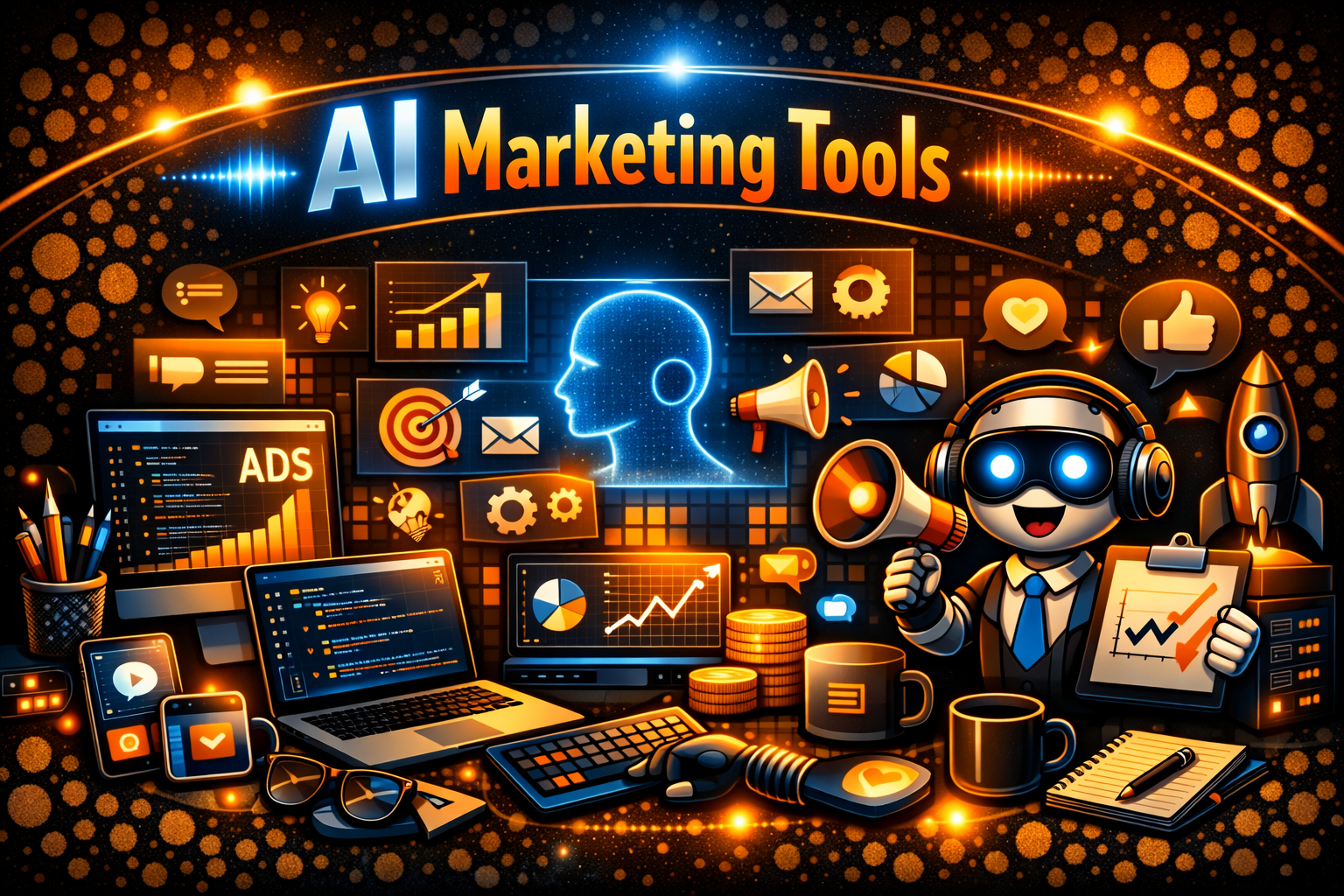
AI Marketing Tools: Complete Guide
AI marketing tools changed how I plan, create, and scale campaigns. They turned marketing from guesswork into a data‑driven creative process. I can research, write, design, test, and optimize faster than any traditional workflow — all while keeping the human voice intact.
I don’t use these tools to replace marketers. I use them to amplify strategy. To make creative decisions backed by data, and data decisions guided by creativity. They help me move from idea to execution without losing momentum.
This page is how I understand the AI marketing category after testing everything that matters — the tools that actually help you grow, not just automate.
⭐ Quick Navigation
- What this category is
- Why it matters
- Types of AI marketing tools
- Real use cases
- How they work
- How to choose
- Common mistakes
- My simple framework
- Internal links
- Final thoughts
⭐ Category Snapshot
What it is: Tools that use AI to plan, create, analyze, and optimize marketing campaigns. Who uses it: Founders, marketers, creators, agencies, and growth teams. What problems it solves: Content bottlenecks, inconsistent messaging, poor targeting, and slow analytics. Where it fits: Content creation, SEO, ads, email, social media, and analytics.
⭐ What AI Marketing Tools Actually Are
AI marketing tools combine language models, analytics, and automation to help you:
- research keywords and audiences
- write and design content
- generate ad copy and visuals
- personalize campaigns
- analyze performance
- optimize conversions
- automate reporting
They’re not about replacing creativity — they’re about scaling it.
⭐ Why AI Marketing Tools Matter
Marketing used to be slow and manual. Every campaign meant hours of research, writing, and testing. Traditional workflows involve:
- brainstorming ideas
- writing copy
- designing assets
- running A/B tests
- analyzing results
AI tools compress that entire cycle. They let you:
- create campaigns instantly
- test variations automatically
- personalize content at scale
- track performance in real time
- make faster, smarter decisions
For founders and marketers, this is leverage.
⭐ Types of AI Marketing Tools
After testing everything from Jasper to Copy.ai to HubSpot AI, the category breaks into clear groups.
1. AI Content Creation Tools
Generate blogs, ads, emails, and social posts. Use when you need speed and consistency.
2. AI SEO Tools
Research keywords, optimize pages, and track rankings. Use when you need visibility and authority.
3. AI Ad Tools
Write, test, and optimize ad copy automatically. Use when you need conversions and scale.
4. AI Analytics Tools
Interpret data, forecast trends, and measure ROI. Use when you need insight and precision.
5. AI Automation Tools
Connect workflows, schedule posts, and trigger campaigns. Use when you need efficiency and control.
⭐ Real Use Cases
Here’s where I use AI marketing tools every week.
Content & SEO
- blog writing
- keyword research
- on‑page optimization
- link building
Ads & Campaigns
- ad copy generation
- creative testing
- audience targeting
- performance tracking
Email & CRM
- personalized outreach
- automated follow‑ups
- segmentation
- analytics
Social & Brand
- post scheduling
- caption generation
- trend analysis
- engagement optimization
If it involves marketing, AI tools make it faster and smarter.
⭐ How AI Marketing Tools Work (Simple Explanation)
Most tools follow the same pattern:
- You input goals, data, or prompts.
- The model interprets your intent.
- It generates, analyzes, or automates content.
- You refine and publish.
- It tracks performance and learns from results.
The real difference between tools comes from:
- model quality
- integration depth
- analytics accuracy
- creative flexibility
- workflow fit
Two tools can produce completely different outcomes from the same brief.
⭐ How I Choose the Right AI Marketing Tool
Here’s how I personally decide what to use.
If I want speed → I choose a content tool
Perfect for writing and ideation.
If I want visibility → I choose an SEO tool
Perfect for ranking and optimization.
If I want scale → I choose an ad tool
Perfect for testing and automation.
If I want clarity → I choose an analytics tool
Perfect for insight and reporting.
If I want control → I choose an automation tool
Perfect for scheduling and workflows.
⭐ Common Mistakes I See
These are the mistakes that slow marketers down:
- relying on AI without strategy
- skipping human editing
- ignoring data validation
- chasing novelty instead of results
- using too many overlapping tools
Avoid these and your campaigns instantly improve.
⭐ My Simple Framework
This is the model I use to evaluate AI marketing tools:
1. Does it save time and increase clarity?
If not, it’s noise.
2. Does it fit my brand voice?
Authenticity beats automation.
3. Does it connect to my workflow?
Integration is everything.
⭐ Final Thoughts
AI marketing tools didn’t just make campaigns faster — they made them smarter. I can test, iterate, and scale ideas without losing the human touch. That balance between automation and authenticity is where the real power lies.
The best tools don’t replace creativity; they accelerate it. They help you think clearer, move faster, and build campaigns that actually connect.
If marketing has ever felt slow or scattered, AI marketing tools will change how you create — the same way they changed how I build everything.