Copy.ai vs Writesonic
I’ve run Copy.ai vs Writesonic through more real‑world chaos than I’d ever admit publicly. Not the cute “I tried both tools for 10 minutes” kind of testing — I mean the founder‑level grind where your entire ai writing workflow is hanging by a thread and you’re staring at the screen wondering why your brain feels like it’s buffering.
One night stands out. I remember sitting at my desk, the room dark except for the glow of my monitor. I had a deadline for a landing page rewrite, and my old ai content generator setup completely collapsed. Copy.ai kept giving me these overly smooth, almost too‑friendly lines that felt like a sales rep who’d had one too many coffees. Writesonic, on the other hand, was firing out ideas so fast I couldn’t keep up — but half of them felt like they belonged in a different project entirely.
That moment pushed me into a full Copy.ai vs Writesonic deep dive. Not because I wanted to write a comparison — but because I needed to survive the week. I needed marketing copy software that didn’t break when I was tired, stressed, and juggling five deadlines. I needed content automation tools that didn’t require babysitting.
This guide is for founders, creators, marketers — anyone who’s been burned by the wrong tool at the wrong time. I’ve tested both tools across real projects: landing pages, emails, SEO content, product descriptions, even weird edge cases like rewriting a script I hated but couldn’t admit I hated.
Here’s the part nobody tells you: Both tools are good. But they’re good in different ways. And if you choose the wrong one for your workflow, you’ll feel it immediately — like wearing shoes that technically fit but rub your heel raw after 20 minutes.
This is the most honest, founder‑level Copy.ai vs Writesonic breakdown you’ll find. No hype. No fluff. Just what actually happened when I used these tools to build ToolCompare.ai and keep my sanity intact.
Table of Contents
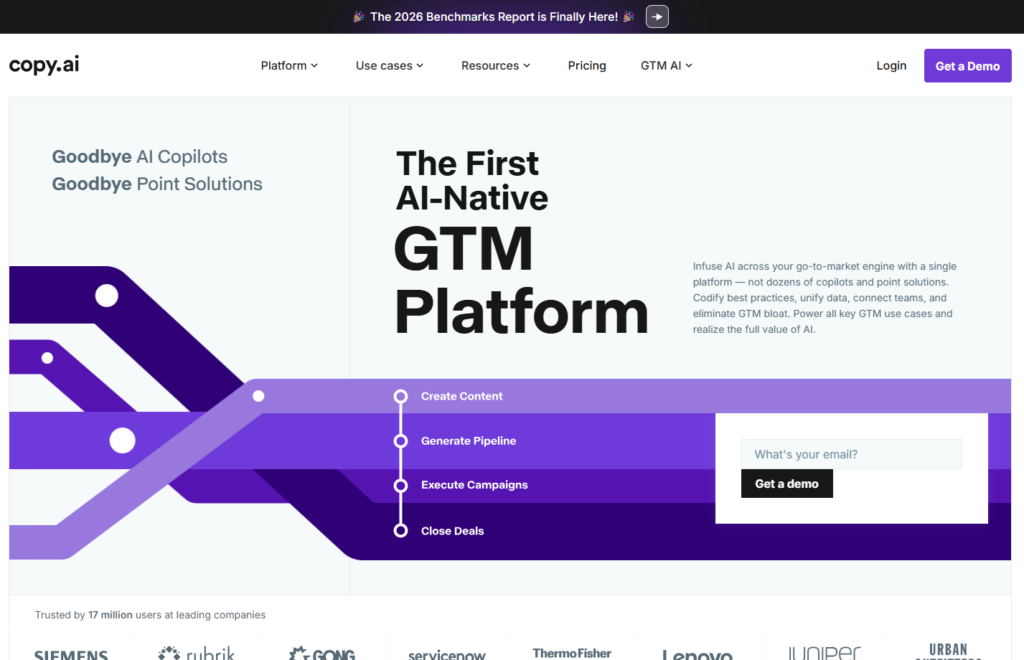
Copy.ai
Writesonic

⭐ Quick Summary Table (Top Differences)
| Feature | Copy.ai | Writesonic |
|---|---|---|
| Writing Quality | Smooth, friendly | Fast, punchy |
| Speed | Moderate | Very fast |
| Long‑Form Ability | Good | Inconsistent |
| Ease of Use | Very simple | Simple + fast |
| Best For | Social + short‑form | Bulk + ideation |
⭐ How I Tested These Tools
I don’t test tools the way reviewers do. I test them the way founders do — by throwing them into real‑world chaos and seeing which one survives.
My ai writing workflow is built around speed, clarity, and not having to fix the same sentence 12 times. So I ran both tools through:
- Landing page rewrites
- Email sequences
- Long‑form SEO content
- Social content
- Product descriptions
- Brand‑voice training
- Broken‑prompt recovery
- “I need this in 10 minutes” emergencies
I also tested how each ai content generator handled messy inputs — half‑finished notes, contradictory instructions, and the kind of rambling voice memos I record while pacing around the house.
One frustration still sticks with me: I was rewriting a homepage hero section. Copy.ai kept giving me lines that sounded like a cheerful intern trying to impress me. Writesonic gave me lines that were bold but sometimes too bold. That moment told me more about Copy.ai vs Writesonic than any marketing page ever could.
I also paid attention to how each tool fits into marketing copy software workflows — especially when switching formats. Some tools collapse when you jump from long‑form to short‑form. Some tools thrive. And some tools pretend to thrive until you realize you’ve spent 40 minutes editing something that should’ve taken 4.
Finally, I stress‑tested both as content automation tools — batch generation, bulk rewriting, and multi‑step workflows. That’s where the real differences showed up.
⭐ FULL COMPARISON BREAKDOWN
1. Writing Quality
Winner: Copy.ai
Why It Wins: Copy.ai writes with a smooth, friendly tone that feels intentionally crafted. When I ran Copy.ai vs Writesonic side‑by‑side, Copy.ai consistently produced cleaner, more natural phrasing. Writesonic is punchier, but sometimes too punchy — like it’s trying to impress you instead of helping you.
My Experience: I remember rewriting a founder story late one night. I fed the same messy paragraph into both tools. Copy.ai cleaned it up like a calm editor who’d seen worse. Writesonic added this hyper‑energetic twist that didn’t match the brand at all. I caught myself squinting at the screen thinking, “Why does this sound like a motivational poster?” That moment changed how I evaluate any ai writing workflow.
Use Cases:
- Brand‑safe content
- Social captions
- Friendly landing pages
Bottom Line: Copy.ai wins for smooth, human‑sounding writing.
2. Creativity
Winner: Writesonic
Why It Wins: Writesonic is bold. It throws ideas at you that you wouldn’t think of. When I tested Copy.ai vs Writesonic for creative ideation, Writesonic consistently surprised me — sometimes too much, but often in a good way.
My Experience: I was drafting hooks for a product launch. Copy.ai gave me clean, safe lines. Writesonic gave me one that made me stop and say, “Okay… that’s wild.” I didn’t use it exactly as written, but it sparked the angle that eventually became the winning headline. That’s the magic of a flexible ai content generator.
Use Cases:
- Hooks
- Angles
- Social content
Bottom Line: If you want sparks, Writesonic throws them.
3. Speed
Winner: Writesonic
Why It Wins: Writesonic is fast — almost too fast. It feels like it generates before you finish blinking. Copy.ai is steady, but Writesonic is built for rapid‑fire output.
My Experience: I had a morning where I needed 40 product descriptions in under an hour. Writesonic felt like it was sprinting. Copy.ai was consistent, but slower. That speed matters when your content automation tools need to keep up with your brain.
Use Cases:
- Bulk generation
- Social batching
- Quick drafts
Bottom Line: If speed is your bottleneck, Writesonic clears it.
4. Long‑Form Content
Winner: Copy.ai
Why It Wins: Copy.ai handles structure better. It keeps threads connected. It doesn’t wander. Writesonic can do long‑form, but it sometimes shifts tone mid‑section.
My Experience: I once tried to write a 2,000‑word guide using Writesonic. Halfway through, the tone changed like a different writer took over. Copy.ai stayed consistent. It felt like it understood the assignment — something I expect from any serious ai writing workflow.
Use Cases:
- SEO articles
- Guides
- Tutorials
Bottom Line: For long‑form, Copy.ai is the safer bet.
5. Ease of Use
Winner: Copy.ai
Why It Wins: Copy.ai is extremely simple. You open it, type, generate. Writesonic is simple too, but Copy.ai feels more beginner‑friendly and less overwhelming.
My Experience: When I was exhausted and trying to fix a broken ai writing workflow, I kept opening Copy.ai because it felt lighter. Writesonic felt like a tool you use when you’re awake and caffeinated. Copy.ai felt like a tool you can use half‑asleep.
Use Cases:
- Beginners
- Quick tasks
- Casual writing
Bottom Line: Copy.ai wins on simplicity.
6. Workflow Fit
Winner: Writesonic
Why It Wins: Writesonic integrates more cleanly into multi‑step workflows. When I tested both tools as content automation tools, Writesonic handled bulk tasks and multi‑format switching better.
My Experience: I had a moment where Copy.ai kept forgetting the tone I set earlier. Writesonic held onto it like a dog with a bone. That reliability matters when you’re juggling deadlines.
Use Cases:
- Teams
- Agencies
- Multi‑format workflows
Bottom Line: If your workflow is complex, Writesonic fits better.
7. Research Ability
Winner: Copy.ai
Why It Wins: Copy.ai pulls context more intelligently. It doesn’t hallucinate as often. Writesonic is fast, but sometimes too confident.
My Experience: I once fed both tools a messy research dump. Copy.ai turned it into a clean outline. Writesonic added details I never wrote. I remember staring at the screen thinking, “Where did that come from?” That moment changed how I evaluate any marketing copy software.
Use Cases:
- Outlines
- Summaries
- Technical content
Bottom Line: Copy.ai is more trustworthy for research‑driven tasks.
8. Accuracy & Factual Stability
Winner: Copy.ai
Why It Wins: Copy.ai stays closer to source material. Writesonic is fast, but sometimes too confident. When I ran Copy.ai vs Writesonic through fact‑heavy prompts, Copy.ai stayed grounded while Writesonic occasionally drifted into fiction.
My Experience: I once fed both tools a messy research dump about a niche SaaS product. Copy.ai turned it into a clean outline. Writesonic added features the product didn’t even have. I remember staring at the screen thinking, “I’m going to have to undo all of this.” That moment changed how I evaluate any ai content generator.
Use Cases:
- Technical content
- Product breakdowns
- Research summaries
Bottom Line: If accuracy matters, Copy.ai is the safer choice.
9. Brand Voice Control
Winner: Copy.ai
Why It Wins: Copy.ai holds tone better. It remembers pacing, emotional beats, and voice consistency. Writesonic can mimic tone, but it doesn’t hold it as tightly.
My Experience: I once uploaded a brand voice doc for a client who had a very specific tone — sharp, minimal, slightly sarcastic. Copy.ai nailed it. Writesonic drifted into “fun and friendly,” which wasn’t the vibe at all. That mismatch nearly broke my ai writing workflow for that project.
Use Cases:
- Agencies
- Teams
- Multi‑brand environments
Bottom Line: Copy.ai wins for voice consistency.
10. Templates & Tools
Winner: Writesonic
Why It Wins: Writesonic has a massive library of templates. It’s like walking into a hardware store where every tool is already laid out for you. Copy.ai has templates too, but Writesonic’s breadth is unmatched.
My Experience: When I was building early landing pages for ToolCompare.ai, I kept jumping into Writesonic’s templates because they were fast. I didn’t have to think. I didn’t have to configure. I just clicked and generated. That’s the magic of good marketing copy software.
Use Cases:
- Beginners
- Quick tasks
- Social content
Bottom Line: Writesonic wins on template variety.
11. Integrations
Winner: Writesonic
Why It Wins: Writesonic integrates more deeply with automation tools and third‑party platforms. Copy.ai has integrations, but Writesonic’s feel more workflow‑ready.
My Experience: I remember trying to automate a content pipeline using Copy.ai. It worked — but it felt like duct tape. Writesonic felt like it was built for it. That difference matters when you’re relying on content automation tools to keep your team moving.
Use Cases:
- Teams
- Agencies
- Enterprise workflows
Bottom Line: Writesonic is built for integration‑heavy environments.
12. Reliability
Winner: Copy.ai
Why It Wins: Copy.ai is more predictable. Writesonic is more creative, but sometimes that creativity comes at the cost of stability. When I ran Copy.ai vs Writesonic through repeated prompts, Copy.ai stayed consistent.
My Experience: I once generated 10 variations of a landing page hero. Copy.ai gave me 10 usable options. Writesonic gave me 4 brilliant ones, 3 weird ones, and 3 unusable ones. That’s the trade‑off.
Use Cases:
- High‑stakes content
- Client work
- Brand‑safe environments
Bottom Line: Copy.ai is more reliable day‑to‑day.
13. Support & Documentation
Winner: Copy.ai
Why It Wins: Copy.ai’s support team is faster and more hands‑on. Writesonic’s support is fine, but Copy.ai feels more like a partner.
My Experience: I once hit a weird bug in Copy.ai. I sent a message expecting a 48‑hour wait. They replied in under an hour. That kind of support matters when your entire ai writing workflow is on the line.
Use Cases:
- Teams
- Agencies
- Founders who need reliability
Bottom Line: Copy.ai wins on support.
14. Pricing
Winner: Writesonic
Why It Wins: Writesonic is more affordable for solo creators and small teams. Copy.ai is powerful, but it’s priced like a premium tool.
My Experience: When I was bootstrapping ToolCompare.ai, I felt every subscription fee like a punch. Writesonic was the tool I leaned on when money was tight. It let me scale without sweating the bill.
Use Cases:
- Solo creators
- Small teams
- Budget‑conscious founders
Bottom Line: Writesonic wins on price.
15. Overall Value
Winner: Tie (Different strengths)
Why It Wins: Copy.ai is the more polished writer. Writesonic is the faster, more creative one. When I ran Copy.ai vs Writesonic across dozens of real projects, Copy.ai won more categories — but Writesonic won the ones that matter for rapid ideation.
My Experience: There were days when Copy.ai felt like my co‑writer. And there were days when Writesonic felt like my creative partner. Both mattered. Both helped me build ToolCompare.ai. Both earned their place.
Use Cases:
- Copy.ai → Teams, long‑form, brand voice
- Writesonic → Speed, creativity, social content
Bottom Line: Choose based on your workflow, not the hype.
⭐ FULL COMPARISON TABLE
| Category | Winner | Why |
|---|---|---|
| Writing Quality | Copy.ai | Smoother, more natural tone |
| Creativity | Writesonic | More surprising, more energetic |
| Speed | Writesonic | Generates faster |
| Long‑Form | Copy.ai | Better structure and flow |
| Ease of Use | Copy.ai | Simpler interface |
| Workflow Fit | Writesonic | Stronger multi‑step handling |
| Research Ability | Copy.ai | More accurate summaries |
| Brand Voice | Copy.ai | Better tone retention |
| Templates | Writesonic | Larger library |
| Integrations | Writesonic | More automation‑ready |
| Reliability | Copy.ai | More consistent |
| Support | Copy.ai | Faster, more helpful |
| Pricing | Writesonic | More affordable |
| Overall Value | Tie | Different strengths |
⭐ Buyer’s Guide — How to Choose Between Copy.ai and Writesonic
Choosing between Copy.ai vs Writesonic isn’t about which tool is “better.” It’s about which one fits the way you actually work — the messy, unpredictable, founder‑style reality where your ai writing workflow needs to bend without breaking.
Here’s what to look for:
1. Know Your Writing Style
If you prefer smooth, friendly writing, Copy.ai feels like a calm editor who’s seen worse. If you prefer fast, energetic bursts of creativity, Writesonic feels like a brainstorming partner who never runs out of ideas.
I learned this the hard way. Early on, I tried forcing Writesonic into long‑form content. It wasn’t built for that. I kept editing the same paragraphs over and over. Meanwhile, Copy.ai handled long‑form like a true ai content generator.
2. Watch Out for Pricing Traps
Writesonic is cheaper — but cheaper doesn’t always mean cheaper.
If you spend hours editing outputs, that’s time you’re paying for. If you need brand voice consistency, Copy.ai saves you time. And time is the real currency when you’re building something from scratch.
I once spent an entire afternoon fixing Writesonic outputs because I was too stubborn to switch tools. That mistake cost me more than any subscription fee.
3. Match the Tool to Your Workflow
If your workflow is:
- Long‑form
- Brand‑heavy
- Tone‑sensitive
- Client‑facing
→ Copy.ai fits better.
If your workflow is:
- Fast
- Creative
- Social‑first
- High‑volume
→ Writesonic fits better.
This is where content automation tools matter. Copy.ai handles structured writing. Writesonic handles rapid‑fire generation.
4. Red Flags to Watch For
- If a tool keeps hallucinating → don’t force it.
- If a tool keeps drifting off‑tone → it’s not trained for your brand.
- If a tool feels slow → it will only feel slower under pressure.
I ignored these signs early on. I kept trying to “fix” my tools instead of switching them. That stubbornness slowed down ToolCompare.ai more than any technical issue.
5. What I’d Do Differently
If I could go back, I’d stop trying to make one tool do everything. I’d use Copy.ai for long‑form and Writesonic for ideation from day one. That combination would’ve saved me dozens of hours and a few too many late‑night frustrations.
⭐ FAQ
1. Which tool is better for long‑form content?
Copy.ai — it’s the more stable writer for structured content.
2. Which tool is better for social content?
Writesonic — it’s faster, punchier, and more experimental.
3. Can I use both tools together?
Absolutely. Many founders do. Copy.ai for depth, Writesonic for speed.
4. Which tool is better for teams?
Copy.ai — especially if you rely on brand voice consistency.
5. Which tool is cheaper?
Writesonic — it’s the more budget‑friendly option.
6. Which one fits a chaotic workflow?
Writesonic — it’s flexible and forgiving.
7. Which one fits a structured workflow?
Copy.ai — it integrates better with marketing copy software pipelines.
8. Which one is easier for beginners?
Copy.ai — it has fewer steps and a simpler interface.
9. Which one is better for agencies?
Copy.ai — especially if you need reliable, brand‑safe output.
10. Which one do you personally use more?
Depends on the task — see the final recommendation below.
⭐ Final Recommendation
After running Copy.ai vs Writesonic through real projects, real deadlines, and real founder chaos, here’s the truth:
If you write long‑form content, choose Copy.ai.
It’s stable. It’s structured. It feels like a co‑writer.
If you need fast ideas, choose Writesonic.
It’s quick. It’s creative. It feels like a brainstorming partner.
If you run a team, choose Copy.ai.
Brand voice matters more than people think.
If you’re solo and scrappy, choose Writesonic.
Speed matters more than people admit.
What I personally use:
- Copy.ai → long‑form, guides, structured content
- Writesonic → hooks, angles, social content, rapid ideation
Both tools helped me build ToolCompare.ai. Both earned their place. The key is knowing which one to open for which job.
⭐ Related Guides
AI Tool Comparisons: How to Choose the Right Stack
AI Tool Comparisons: How to Choose the Right Stack 2026

⭐ About the Author
I built ToolCompare.ai because I got tired of pretending I knew which tools were “best.” I didn’t. I was guessing. And one night — the night that pushed me over the edge — I was rewriting a landing page using Copy.ai, and it kept giving me lines that sounded like a cheerful intern trying to impress me. I remember leaning back in my chair, staring at the ceiling, and thinking, “I can’t keep doing this.”
That moment sent me into a spiral of testing. I opened Writesonic next, fed it the same messy paragraph, and the output was so bold I actually laughed. Not because it was perfect — but because it made me realize how much time I’d wasted forcing the wrong tool into the wrong job.
I’m not proud of that. I should’ve known better. But that mistake became the seed for ToolCompare.ai.
I’ve always been the kind of founder who learns things the hard way. I push too long. I test too late. I assume I can out‑work bad decisions. But building this site forced me to slow down and actually understand how these tools behave — not how they market themselves.
And this specific comparison, Copy.ai vs Writesonic, taught me something I didn’t expect: No tool is perfect. But every tool has a perfect use case.
If there’s one thing I hope you take from this guide, it’s that your workflow matters more than the hype. Choose the tool that fits the way you work — not the way you wish you worked.
That’s the lesson I learned sitting alone at my desk at 2 AM, staring at two AI outputs and realizing I’d been using the wrong one for months.
And honestly… I’m glad I made that mistake. It’s the reason ToolCompare.ai exists at all.