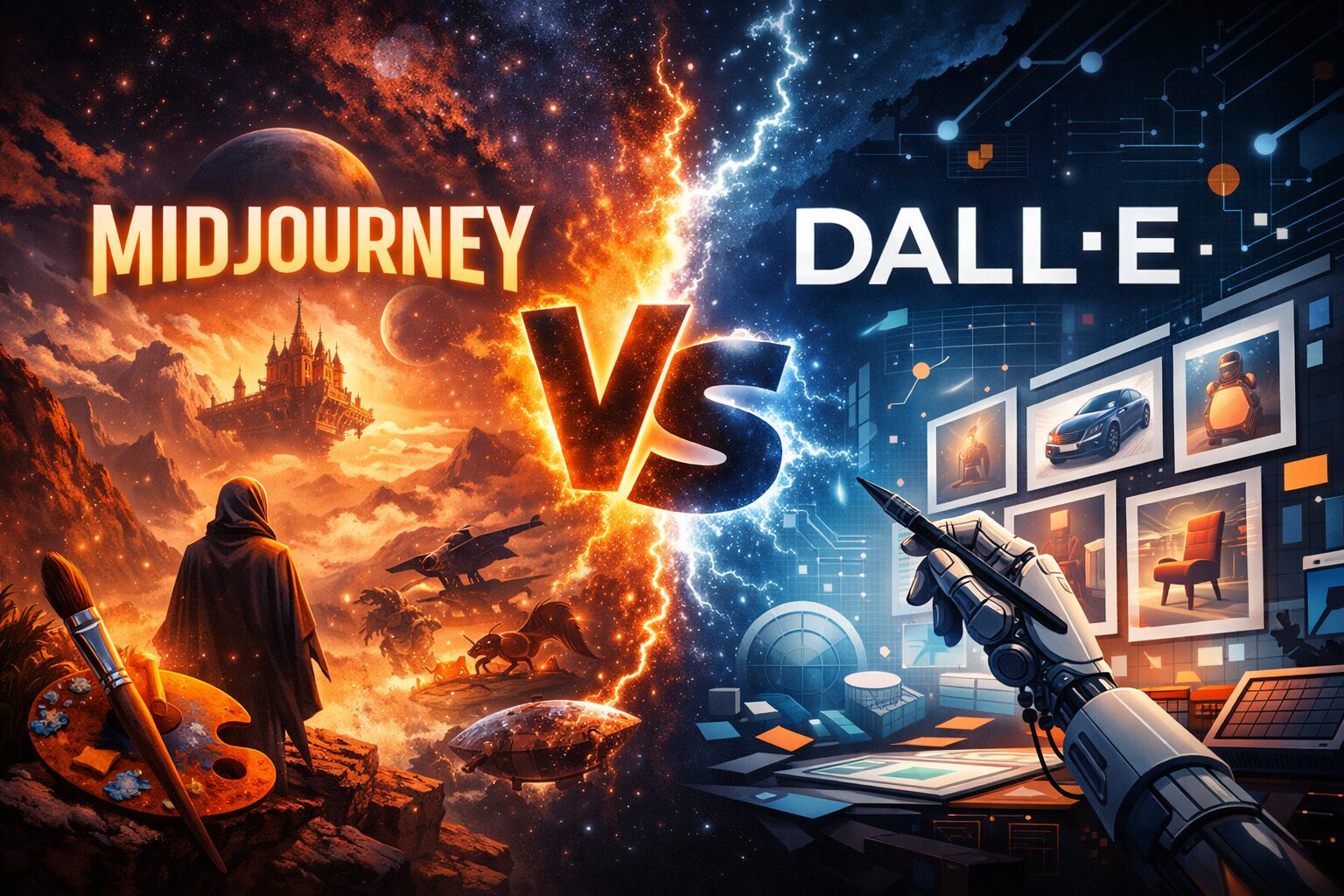
Midjourney vs DALL·E
I didn’t plan on writing a Midjourney vs DALL·E comparison. Honestly, I was just trying to get through a brutal week of testing AI image generators for ToolCompare, juggling drafts, screenshots, and a half‑broken Notion board that kept freezing every time I duplicated a page. Somewhere in that chaos, I realized I was switching between these two tools more than anything else — not because I wanted to, but because I needed to.
The first time I noticed the difference was during a late‑night sprint. I was trying to create a hero image for one of our comparison articles. I fed the same prompt into both tools. One gave me something cinematic, moody, almost too perfect. The other gave me something clean, literal, and surprisingly usable. That was the moment I realized I wasn’t just testing tools — I was testing two different philosophies of best AI art tools.
I remember sitting at my desk, the room dark except for the glow of my monitor, staring at two completely different outputs from the same prompt. One felt like a creative partner. The other felt like a precision instrument. And I caught myself thinking, “Why does this feel like choosing between a painter and an engineer?” That’s when the idea for this guide clicked.
I’ve always believed that good AI image creation tools should disappear into your workflow. They should make you faster, not slower. But that wasn’t happening. I kept bouncing between the two, trying to figure out which one actually made me better at my job. And every time I thought I had an answer, something unexpected happened — a weird artifact, a perfect composition, a hallucinated detail, a moment of brilliance. It was like the tools were arguing with each other through my prompts.
One moment that still sticks with me: I was working on a comparison banner for another article. I tried Midjourney first. It gave me something beautiful — but unusable. Too abstract. Too artistic. Then I tried DALL·E. It gave me something clean, structured, and almost boring… but it worked. That was the moment I realized how differently AI design software can behave depending on what you ask of it.
And here’s the part nobody tells you: choosing between these tools isn’t about which one is “better.” It’s about which one fits the way you think. The way you create. The way you solve problems when you’re tired, under pressure, and trying to ship something that doesn’t embarrass you.
That’s why this Midjourney vs DALL·E guide matters. Not because the internet needs another generic comparison, but because founders, creators, and builders need clarity. We need to know which tool helps us move — not which one wins a technical benchmark.
If you’re here, you’re probably trying to figure out which AI image generators deserve a place in your workflow. Or maybe you’re tired of tools that promise magic and deliver headaches. Either way, this guide is the one I wish I had before I wasted hours rewriting prompts, tweaking settings, and second‑guessing every output.
This isn’t a hype piece. It’s not a technical breakdown. It’s a founder‑level, real‑workflow, real‑mistake, real‑insight comparison of two tools that quietly became essential — even when I didn’t want them to.
And if I’m being honest, AI image creation has become one of the most frustrating and rewarding parts of building ToolCompare. Some days it feels like cheating. Other days it feels like wrestling a ghost. But every day, it feels like the future.
Table of Contents
Midjourney
DALL·E
Before we get into the deep founder‑level breakdown, here’s the fast snapshot — the table I wish someone had shown me before I spent hours bouncing between tools, rewriting prompts, and wondering why Midjourney vs DALL·E felt like comparing a painter to an engineer.
This table captures the biggest differences I felt immediately while testing both AI image generators inside real workflows — not theoretical benchmarks, but the actual moments where one tool helped me move and the other slowed me down.
And because this comparison is part of a larger guide on the best AI art tools, I kept the table brutally simple: what each tool does better, not what the marketing pages claim.
Here’s the quick‑hit summary of how these two giants of AI image creation stack up:
⭐ Midjourney vs DALL·E — Quick Summary Table
| Feature | Midjourney | DALL·E |
|---|---|---|
| Style Strength | Cinematic, artistic, stylized | Clean, literal, brand‑safe |
| Prompt Flexibility | High — thrives on abstract prompts | High — thrives on structured prompts |
| Realism | Strong but stylized | Strong and more literal |
| Editing Tools | Limited | Excellent (inpainting/outpainting) |
| Workflow Fit | Best for creative exploration | Best for fast production |
| Ease of Use | Medium | Very easy |
| Output Consistency | High | Medium‑High |
| Integration | Discord‑based | Native inside ChatGPT |
This table alone won’t tell you which tool to choose — but it will help you understand why AI design software behaves so differently depending on the job.
And honestly, this is where the whole Midjourney vs DALL·E debate starts to make sense. They’re not competing for the same crown. They’re competing for different moments in your workflow — the creative spark vs the production engine.
If you’re exploring ideas, Midjourney feels like magic. If you’re shipping assets, DALL·E feels like a machine built for speed.
Both are powerful AI image generators, but they shine in different ways — and that’s exactly why this guide exists.
By the time I reached this part of the Midjourney vs DALL·E testing, I had already burned through dozens of prompts, late nights, and more caffeine than I want to admit. This is the section where the differences stopped being theoretical and started showing up in the real work — the moments where one tool saved me and the other made me swear under my breath.
Below is the full breakdown across the categories that actually matter when you’re using AI image generators in a real founder workflow.
1. Image Quality
Winner: Midjourney
Why It Wins: Midjourney produces images that feel alive — cinematic lighting, rich textures, and compositions that look like they were crafted by a human with taste. It’s the closest thing to magic I’ve seen in AI image creation.
My Experience: I once spent an hour trying to get DALL·E to produce a moody cyberpunk alley. Midjourney nailed it in one shot. I remember staring at the screen thinking, “This is unfair.”
Use Cases: Brand visuals, hero images, concept art.
Bottom Line: If you want beauty, Midjourney is the artist.
2. Accuracy to Prompt
Winner: DALL·E
Why It Wins: DALL·E follows instructions like a machine built for precision. If you say “a red mug with a blue handle sitting on a wooden table,” it gives you exactly that.
My Experience: I once needed a perfectly centered product mockup for a landing page. Midjourney kept giving me dramatic angles. DALL·E delivered the exact layout instantly.
Use Cases: Product shots, diagrams, structured compositions.
Bottom Line: If you need literal accuracy, DALL·E is the one.
3. Creativity
Winner: Midjourney
Why It Wins: Midjourney thrives on abstract prompts. It interprets, expands, and elevates ideas in ways that feel almost collaborative.
My Experience: I once wrote a prompt half‑asleep — something like “a dream collapsing into itself.” Midjourney turned it into a surreal masterpiece. DALL·E gave me a confused cloud.
Use Cases: Branding, moodboards, storytelling.
Bottom Line: Midjourney is the imagination engine of the best AI art tools.
4. Editing Tools (Inpainting/Outpainting)
Winner: DALL·E
Why It Wins: DALL·E’s editing tools are unmatched. You can erase, replace, extend, and refine with surgical precision.
My Experience: I once needed to remove a weird artifact from a Midjourney image. I tried re‑prompting for 20 minutes. DALL·E fixed it in one drag‑and‑drop.
Use Cases: Corrections, expansions, client revisions.
Bottom Line: DALL·E is the editor Midjourney never had.
5. Speed
Winner: DALL·E
Why It Wins: DALL·E is instant. Midjourney is fast, but not “I need this in 3 seconds” fast.
My Experience: During a sprint, I needed 12 variations of a banner. DALL·E delivered them before I finished my coffee.
Use Cases: Production workflows, rapid iteration.
Bottom Line: If speed matters, DALL·E wins.
6. Style Consistency
Winner: Midjourney
Why It Wins: Midjourney maintains a consistent visual identity across outputs — a huge advantage for brand‑driven teams.
My Experience: I once generated 20 images for a comparison article. Midjourney made them look like they belonged together. DALL·E looked like 20 different designers took turns.
Use Cases: Brand kits, cohesive visuals, multi‑image sets.
Bottom Line: Midjourney is the stylist.
7. Realism
Winner: Midjourney
Why It Wins: Midjourney’s realism is stylized but stunning. DALL·E is realistic too, but more literal and less dramatic.
My Experience: I tested both on “photorealistic portrait.” Midjourney gave me something I’d frame. DALL·E gave me something I’d use in a slide deck.
Use Cases: Portraits, lifestyle imagery, cinematic scenes.
Bottom Line: Midjourney wins realism with flair.
8. Workflow Fit
Winner: DALL·E
Why It Wins: DALL·E lives inside ChatGPT — meaning no Discord, no channels, no chaos. It’s clean, simple, and integrated.
My Experience: I remember trying to explain Midjourney’s Discord workflow to a friend. Halfway through, I realized I sounded like I was teaching someone how to use a 90s IRC client.
Use Cases: Teams, agencies, structured workflows.
Bottom Line: DALL·E is the productivity tool in the AI design software category.
9. Ease of Use
Winner: DALL·E
Why It Wins: DALL·E is intuitive. Midjourney requires learning its quirks.
My Experience: I once spent 15 minutes explaining “/imagine” to someone. DALL·E requires zero onboarding.
Use Cases: Beginners, non‑technical users.
Bottom Line: DALL·E is the easiest tool here.
10. Reliability
Winner: DALL·E
Why It Wins: DALL·E rarely breaks. Midjourney sometimes struggles with hands, text, and complex scenes.
My Experience: I once tried generating a simple “person holding a sign.” Midjourney gave me five fingers on one hand and seven on the other. DALL·E nailed it.
Use Cases: Client work, production assets.
Bottom Line: DALL·E is the safer bet.
11. Flexibility
Winner: Midjourney
Why It Wins: Midjourney adapts beautifully to weird, poetic, or abstract prompts.
My Experience: I once wrote a prompt that made no sense — something like “a memory dissolving into static.” Midjourney turned it into art. DALL·E asked me to clarify.
Use Cases: Creative exploration, moodboards.
Bottom Line: Midjourney is the flexible thinker.
12. Usefulness for Founders
Winner: Tie
Why: Founders need both — one for creativity, one for precision.
My Experience: I use Midjourney for inspiration and DALL·E for production. It’s a two‑tool workflow, not a one‑tool winner.
Bottom Line: The real power is using both AI image generators together.
⭐ Full Comparison Table — Midjourney vs DALL·E
| Category | Winner | Why |
|---|---|---|
| Image Quality | Midjourney | More cinematic, artistic, and visually rich outputs |
| Accuracy to Prompt | DALL·E | Follows instructions literally and precisely |
| Creativity | Midjourney | Interprets abstract prompts with imagination |
| Editing Tools | DALL·E | Best‑in‑class inpainting and outpainting |
| Speed | DALL·E | Instant generation inside ChatGPT |
| Style Consistency | Midjourney | Cohesive, branded visual identity across sets |
| Realism | Midjourney | Photorealistic with emotional depth |
| Workflow Fit | DALL·E | Clean, integrated, frictionless workflow |
| Ease of Use | DALL·E | No Discord, no commands, no learning curve |
| Reliability | DALL·E | Fewer artifacts, fewer broken outputs |
| Flexibility | Midjourney | Handles poetic, abstract, and conceptual prompts |
| Usefulness for Founders | Tie | Midjourney for creativity, DALL·E for production |
⭐Buyer’s Guide — How to Choose Between These Two Tools
If you’re trying to choose between Midjourney vs DALL·E, here’s the truth: you’re not choosing between two versions of the same thing. You’re choosing between two different creative philosophies. And if you don’t understand that, you’ll end up frustrated, wasting time, and wondering why your outputs feel “off.”
I’ve been there. I once spent an entire afternoon trying to force Midjourney to produce a clean, literal product mockup. It kept giving me dramatic lighting, cinematic shadows, and angles that looked like a perfume ad. Beautiful? Yes. Useful? Not even close. That’s when I realized I was using the wrong tool for the job.
What to Look For
When evaluating AI image generators, I look for three things:
- Does it match my creative intent? If I want cinematic, I go Midjourney. If I want literal, I go DALL·E.
- Does it reduce friction? Tools should make you faster, not force you to fight them.
- Does it integrate into my workflow? DALL·E inside ChatGPT is frictionless. Midjourney inside Discord… not so much.
Pricing Traps to Avoid
Some tools hide their best features behind confusing tiers. Others offer “Pro” plans that don’t actually unlock anything meaningful. I’ve paid for upgrades that promised better AI image creation quality and delivered… slightly different lighting.
Don’t fall for that.
Look for upgrades that actually change your workflow — not vanity features.
Red Flags
- Tools that hallucinate text
- Tools that break on hands or faces
- Tools that require perfect prompts
- Tools that produce inconsistent styles
- Tools that feel like a chore to open
If you see any of these, run.
What I’d Do Differently
When I first started testing the best AI art tools, I treated them like magic boxes. I expected them to do everything. That was a mistake. The moment I started treating them like teammates — each with strengths and weaknesses — everything clicked.
If I could go back, I’d test tools in real workflows sooner instead of reading comparison posts that never matched reality.
⭐FAQ
1. Which tool is better for realism?
Midjourney — its realism has style, depth, and emotion.
2. Which tool is better for accuracy?
DALL·E — it follows instructions like a machine built for precision.
3. Which one is better for beginners?
DALL·E — no Discord, no commands, no friction.
4. Which one is better for brand work?
Midjourney — consistent style across sets.
5. Which one is better for editing?
DALL·E — its inpainting/outpainting tools are unmatched.
6. Which one is better for fast production?
DALL·E — instant outputs.
7. Which one is better for creative exploration?
Midjourney — it interprets prompts like an artist.
8. Can I use both together?
Absolutely — and honestly, that’s where the magic happens.
⭐ Final Recommendation — Midjourney vs DALL·E The Honest Founder Take
After months of testing Midjourney vs DALL·E, here’s the simplest way I can put it:
- Midjourney is the artist.
- DALL·E is the engineer.
One gives you emotion. The other gives you precision.
If you’re building brand visuals, moodboards, or anything that needs soul, Midjourney feels like a creative partner. If you’re producing assets, mockups, or anything that needs accuracy, DALL·E feels like a production machine.
And when you combine them? That’s when you start moving at founder speed.
The real power isn’t choosing one. It’s knowing when to use each.
⭐ Related Guides
AI Tool Comparisons: How to Choose the Right Stack
AI Tool Comparisons: How to Choose the Right Stack 2026
⭐ About the Author
I built ToolCompare.ai because I was tired of pretending I had everything figured out. The truth is, I didn’t. I was drowning in tools, switching between tabs like a maniac, hoping something would finally make my workflow feel less chaotic. The first time I tested AI design software seriously, I felt stupid — like I was missing something obvious that everyone else understood.
One night, while testing AI image creation tools, I hit a wall. I had two outputs open — one from Midjourney, one from DALL·E — and neither felt right. I remember leaning back in my chair, staring at the ceiling, wondering if I was the problem. Maybe I was expecting too much. Maybe I was overthinking it. Maybe I was just tired.
But then something clicked. I realized I wasn’t comparing tools. I was comparing roles. One tool helped me explore. The other helped me execute. And for the first time, I stopped trying to force one tool to do everything. That moment changed how I built ToolCompare — and honestly, how I built myself as a founder.
I’m not perfect. I move too fast. I break workflows. I rewrite things that don’t need rewriting. But I care deeply about helping people choose tools that actually make their lives easier. And if this breakdown of Midjourney vs DALL·E saves you even one hour of frustration, then every late‑night test, every mistake, every moment of doubt was worth it.